Free training plan
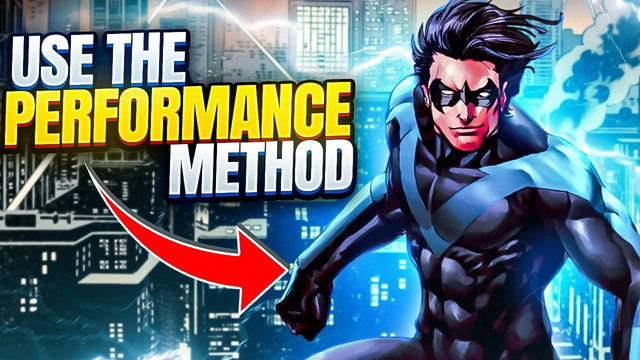
Nightwing Training at Home: Build a Nightwing Physique With No Weights
Watch the full breakdown, or read it below.
Scroll down for the free programIn this post
Nightwing training at home comes down to four things: mobility, bodyweight strength, cardio and moving well. You can train all four with no weights, and a Nightwing physique is lean and athletic more than it is big, so bodyweight work suits it. I built two free plans around them. Level 1 is a three-day plan for beginners and people coming back to training, and all it needs is a sturdy table or a blanket. Level 2 is a four-day plan for when Level 1 stops being hard, and it adds a pull-up bar and a jump rope.
This is the at-home version. If you have a gym and want barbells, kettlebells and sprints, use my Nightwing gym plan in three phases.
How to get a Nightwing physique without weights
In the comics, Dick Grayson grew up as a circus acrobat, so his build came from years of acrobatics, gymnastics and moving his own body around, not from a bench press. Both plans follow that idea: every strength exercise uses your bodyweight, and you make it harder by adding reps and then moving to a tougher version of the movement.
His fighting style is the other half. He stays alive by never standing still, which takes range of motion, the fitness to keep moving and the control to land well. He does it with no powers, against robots and aliens, which says more about his cardio than his common sense.
Is a Nightwing physique achievable? He is a drawing, so I can't promise you a comic panel. Lean, strong for your size and able to move freely is a realistic goal, and it's what these plans train. What stops most people isn't a missing gym. It's feeling too stiff to squat deep or reach overhead, so they skip the positions that would make them more athletic.
The science: why you feel tight
Most people assume they can't touch their toes because their muscles are short. In the video I put it this way: when a joint moves into a position that is unfamiliar or weak, your nervous system limits how far you can go, to keep you safe. The research supports a softer version of that. In stretching programs lasting a few weeks, people could reach further mainly because the stretch felt different to them, not because the muscle had measurably lengthened.
So my approach is to build strength at the end of your range instead of only hanging out there. In my experience as a trainer, getting strong in a deep squat or a long hamstring stretch is what makes the extra range stick around. The research on how lasting this is remains thin, so treat that part as my view.
The usual approach
Stretch and hope
Hold a few long stretches after the workout because your muscles feel short. You may gain some range, but you never practise being strong in it.
The Nightwing approach
Strength at end range
Loaded stretches in the warm-up, then every strength exercise through a full range of motion. You lower under control into the deepest position you can manage without pain.
The Nightwing workout: four keys
1. Mobility. The warm-ups use loaded stretches, such as Cossack squats and a loaded hamstring stretch, plus dead hangs in Level 2. Lower slowly into the deepest stretch you can manage without pain, hold it for one breath, then come back up. Done consistently, that slowly adds range.
2. Strength. The main work is bodyweight exercises paired into supersets, two exercises done back to back, which saves time and keeps your heart rate up. Most sets are AMRAP, as many reps as possible. Add one or two reps to your total each week, and don't go past 30. When 30 is easy, swap in a harder version: bodyweight squats become Bulgarian split squats, push-ups become deficit push-ups. Lower under control and push up fast.
3. Cardio and 4. movement. Real acrobatics take years of practice, and most of us don't have a gymnastics gym or a spare childhood. So each session ends with a circuit of simpler movements that train balance, agility and body awareness while your lungs do the cardio: punches, kicks and bear crawls, plus kick-throughs and jumps like tuck jumps and skater jumps in Level 2. Try to beat your time on it as the weeks go on.
Level 1 or Level 2: where to start
Level 1 (Titan) is the beginner plan. It's three workouts a week, written for people who are new to training or returning after time off. The strength work is push-ups, squats and lunges, table rows or blanket rows, and core holds like hollow holds and planks, followed by four-round circuits. Equipment: a sturdy table or a blanket for the rows. A jump rope is optional (jumping jacks are the listed alternative), and a backpack full of books adds load to the hamstring stretch.
Level 2 (Ascension) is the advanced plan. It's four workouts a week with harder movements: pull-ups and chin-ups, heel-elevated pistol squats, pike and archer push-ups, V-ups, wall walks and reverse Nordic curls. The circuits are six rounds and add squat jumps, burpees, tuck jumps and skater jumps. Equipment: still no weights, but you need a pull-up bar and a jump rope.
Start with Level 1 unless you already train regularly and can do pull-ups. Move up once you can hit around 30 reps on the Level 1 movements. One honest limit: the Level 1 sheet doesn't list easier versions, so if a full push-up isn't there yet, do them with your hands on a bench or the edge of a couch. That's my coaching suggestion, not something written in the plan.
What the research says
Narrative review · not a trial
Short-term flexibility gains are mostly about sensation.
This review looked at why muscles become more extensible after stretching. It concluded that gains after one session and after 3 to 8 week programs mostly reflect a change in how the stretch feels, not a lasting change in the muscle, and that longer programs hadn't been properly tested. That fits the nervous-system idea, but it doesn't prove end-range strength work makes the change permanent.
Meta-analysis · 11 trials
Strength training improved range of motion about as much as stretching.
Across 11 randomized trials with 452 people, there was no significant difference between strength training and stretching for improving range of motion. The trials varied a lot, so this is decent evidence, not a final answer. It supports full-range strength work as mobility training, not that it beats stretching.
Single small study · 18 men
Push-ups built muscle like a matched bench press.
18 young men trained twice a week for 8 weeks. One group bench pressed at 40% of their one-rep max; the other did push-ups adjusted to match that load. Both gained chest and triceps thickness and bench press strength, and only the bench press group added biceps thickness. One small study, and it says nothing about pull-ups or pistol squats, but it backs the idea that bodyweight pushing can build muscle.
Work with me
Want a fully personalized training and nutrition plan built around your schedule? I'll coach you weekly and get you results faster than you thought possible.
See online coachingWhat this plan won't do
It won't teach you a backflip. The circuits build the fitness, balance and coordination that acrobatics sit on, but the skills themselves need a coach and a soft floor. Bodyweight work also gets hard to progress past a point, mostly for your legs. When Level 2 feels comfortable, the gym plan above is the next step, or my Red Hood workout for Jason Todd if you'd like a different member of the Bat family.
The video doesn't cover food, so I'll leave diet out instead of guessing, even though it decides how lean you get. If you'd like training and nutrition set up around your body and your week, that's what I do in online personal training, and you can see how it goes in real client results. If you live here and want a trainer to come to you, I also offer in-home training in Vancouver.
Day 1 of the free Nightwing training plan
I built this program to train like Nightwing at home: Level 1 is three workouts a week, spaced out as evenly as you can. Here's Day 1. Warm up first with 100 jump rope skips or jumping jacks, 12 Cossack squats, 6 loaded hamstring stretches per side (wear or hold a backpack with books for weight) and 6 PNF wall shoulder stretches per side. Each lettered pair is a superset. Then do the circuit: four rounds as quickly as possible, trying to beat your time each week. If you want another at-home option after this, there's my at-home Batman workout.
Free program · Day 1 of 3
Level 1, Day 1: Full body
| # | Exercise · sets × reps |
|---|---|
| Superset | |
| 1a | Push-ups3 × AMRAP |
| 1b | Heel-elevated squats3 × AMRAP |
| Superset | |
| 2a | Table rows or blanket rows3 × AMRAP |
| 2b | Hollow holds3 × hold as long as possible |
| Circuit · 4 rounds as quickly as possible | |
| 3 | Lateral shuffles4 × 12 |
| 4 | Slow front kicks4 × 20 alternating sides |
| 5 | Bear crawl4 × 30 steps |
Free download
Level 1 · Beginner
Level 2 · Advanced
Sources
- Weppler CH, Magnusson SP. Increasing muscle extensibility: a matter of increasing length or modifying sensation? Phys Ther, 2010. Read it
- Afonso J et al. Strength training versus stretching for improving range of motion: a systematic review and meta-analysis. Healthcare (Basel), 2021. Read it
- Kikuchi N, Nakazato K. Low-load bench press and push-up induce similar muscle hypertrophy and strength gain. J Exerc Sci Fit, 2017. Read it